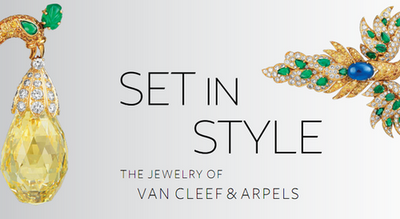
Yesterday marked the opening of the new exhibit
Set in Style: The Jewelry of Van Cleef & Arpels at the Cooper-Hewitt, National Design Museum. It showcases the famed jewelry firm’s contributions to design innovation in the 20th century and includes more than 350 works, including jewels, timepieces, fashion accessories and objets d’art, many commissioned by American clientele. This is the most comprehensive exhibition ever put together of Van Cleef & Arpels’ masterworks.
Organized into six themes: Innovation, Transformation, Nature, Exoticism, Fashion and Personalities, the show brings to light how, since opening on the Place Vendôme in Paris in 1906, Van Cleef & Arpels has been at the forefront of jewelry design and innovation, combining painstaking craftsmanship with unforgettable beauty and style.

One of the most important technical innovations in jewelry design perfected by Van Cleef & Arpels is the “Mystery Setting,” where the setting does not show between the stones, creating a solid field of color. This requires a highly skilled craftsman and a stone specialist, since the stones must not only be cut exactly to fit the setting but also to be matched to exactly the right color. There are many knockout examples on display here but some I particularly loved were the American Bicentennial brooch of 1976, with mystery-set rubies, sapphires and diamonds, the Mystery-Set Ribbon bracelet from 1943, of emeralds, diamonds and platinum, and the 1936 Mystery-Set brooch, shaped like leaves made of rubies, diamonds, yellow gold and platinum.


From the time it opened its doors, Van Cleef & Arpels was known not just for its jewels but its accessories such as the “Minaudière,” an invention of the firm. The Minaudière contained compartments for a compact, lipstick, comb, mirror, calling or dance-card holder (so old school!), pillbox, space for money or a handkerchief, cigarette case (sometimes with a lighter hidden on the side) and many with a hidden clock. Who doesn’t love a multitasking yet elegant clutch? One of my favorites was the Volutes Minaudière from 1935, made of yellow gold, black lacquer and diamonds.

Another hallmark of Van Cleef & Arpels’ work are jewelry pieces that can transform themselves into other different pieces. Look for the Walska bird brooch where the bird’s wings can become earrings and its tail can be made into a brooch. This piece was commissioned to celebrate the owner’s first child and features a stunning 95-carat yellow diamond hanging from the beak of the bird.

The Duchess of Windsor, a renowned lover of jewelry, proposed to Van Cleef & Arpels in 1938 that they create a piece of jewelry that zipped. It was 1951 by time they were able to overcome the technical difficulties in creating what she wanted, a necklace that could be zipped together to make a bracelet. Her famous zip necklace is on display here, made of gold, rubies and diamonds, and shown with the extensions removed and set apart.

The theme of transformation could be applied to Van Cleef & Arpels itself, as the family moved to New York at the outbreak of World War II, with the result that the Parisian company was becoming more and more steeped in American culture and more focused on selling to an American market.

Butterflies are a recurring design motif throughout the history of Van Cleef & Arpels and as such they have made their way into the exhibition. Look for the amazing swirl of butterflies made of Japanese lacquer, found in the museum’s conservatory.
With the excavation of King Tut’s tomb in 1922, Egyptomania swept over the world. Responding to this enthusiasm, Van Cleef & Arpels crafted an “Egyptian” bracelet in 1924, featuring a soaring bird made of emeralds, sapphires and rubies. Also featured here is a silk bag from 1927 topped with an Egyptian odalisque made of gold, two other Egyptian-themed bracelets from 1924, one a Lotus bracelet, the other a bracelet of “Hieroglyphics,” a pyramid pair of lapel clips made of diamonds and platinum, and the Peacock box, circa 1950, made of gold, green and blue enamel and lapis lazuli.

Van Cleef & Arpels have always understood that fashion and jewelry are forever linked and some of the pieces on display showcase how the firm can make stunning works of fashion that perfectly reflect their times. Here are two wonderful examples—a 1968 basketweave purse made of yellow gold and diamonds, and an evening bag from 1927 of gold, black and blue enamel, rock crystal and diamonds.

Van Cleef & Arpels has always had some of the most well-known celebrities, socialites and royalty as clients and the final portion of the exhibit is a hall devoted to them and the glittering things they loved. Call it A Girl and Her Jewels. Three of my favorites are Daisy Fellowes’ “Manchette” emerald and diamond bracelets, which could be fastened together to make a necklace, and an exquisite diamond necklace owned by Eva Peron. Other famous clients represented here include Consuelo Vanderbilt, Barbara Hutton, Jacqueline Kennedy Onassis, Maria Callas, Marlene Dietrich, Greta Garbo, and Elizabeth Taylor.


 Don't cry for her, Argentina. Eva Peron once owned this diamond necklace.
Just past the hall is a case filled with jewelry worn by H.S.H. Princess Grace of Monaco. It features the diamond tiara she wore to the 1978 wedding of her daughter Princess Caroline to Philippe Junot. It also includes the set of necklace, bracelet, earrings and ring of cultured pearls and diamonds she received from Prince Rainier upon their engagement.

I never think of myself as a jewelry person and yet I loved everything I saw. I can’t imagine attending a jewelry exhibition that could top this, there is so much bling on display, on loan from Van Cleef & Arpels’ archives and private collections around the world.
Finally, here is a picture of me with local television reporter Lauren Glassberg. She does terrific segments on ABC Channel 7 about fashion, shopping and restaurants and I always love her work. She was at the museum to film a piece on the exhibition but before she started she was kind enough to pose in a picture with me and got her cameraman Gus to take the shot. Thanks Lauren and Gus!
 Meeting local news hottie Lauren Glassberg, on the left. Photo taken by her cameraman Gus!Set in Style: The Jewelry of Van Cleef & Arpels
 is on view until June 5, 2011.
Cooper-Hewitt, National Design Museum
2 E. 91 Street (at Fifth Avenue)
New York NY 10128
212-849-8400
www.cooperhewitt.org

 Anne Hathaway and Valentino. Photo by John Shearer/Getty Images.
 Marisa Tomei in Charles James. Photo by Kevin Mazur/WireImage.
 Michelle Williams in Chanel Haute Couture. Photo by John Shearer/Getty Images.