Monday, December 31, 2012

Wishing You a Glamorous 2013

James D’Arcy and Andrea Riseborough in W./E.

This image was one of my favorites from the movie W./E., with its romance, glamour, and metallic sweep of the gown worn by Andrea Riseborough as Wallis. Arianne Phillips, the Oscar-nominated costume designer of the film, said in an interview she gave to Lucky magazine in March 2012 that the gown was a Vionnet made of gold lamé. It is sublime!

I wish you all the romance and glamour (and gold lamé) of this picture for 2013!

Happy New Year!

Thursday, December 13, 2012

Christmas in New York 2012: Bergdorf Goodman


I went to Bergdorf Goodman a few weeks ago at night to photograph their holiday 2012 windows, which are as glorious as ever. The details and glamour are always amazing and the clothes, my God, the clothes! I dream in feathers, sequins and beads (was I a Vegas showgirl in my last life?), so the dresses by Marchesa, Tom Ford, Naeem Khan, and Alexander McQueen are just beyond.

The dress is from Marchesa by special order only.


This year’s windows theme is the “BG Follies.” With their jazz age feel they leave me even more excited for next summer’s movie release of The Great Gatsby. I think F. Scott Fitzgerald would love these windows, don’t you?

These weren’t all of the windows but they were definitely my favorites.

A Naeem Khan cape.

Dress by Tom Ford.

Dress and boots by Alexander McQueen.

I love these boots.

Dresses by Naeem Khan by special order.

Naeem Khan’s exquisite beading is inspired by saris from his native India.

This vertiginous window is how it appears as you face it!

I love this look and I love this shot!

I hope you are having a wonderful holiday season!

Tuesday, December 11, 2012

2013: A Big Year for Fashion Illustration

Waiting for the Parade by Samantha Hahn, 2010.

As 2012 draws to a close I feel slightly nostalgic and sad that another year has passed (where did the time go?) and yet excited for all the good things to come in 2013 and I have just learned that fashion illustration is set to have a big year. I couldn’t be more pleased by this. Seeing the excellent exhibit Fashion Illustration: A Contemporary Look at Brooklyn Public Library back in September has made me realize that fashion illustration is just as important as fashion photography. Sometimes it’s even more important!

It’s our friend Bill Cunningham! A 2011 work by Samantha Hahn.

Here are a few New York City fashion illustration events for 2013 I am especially excited about:

January 24 and February 7, 2013

Fashion Drawing Night at Society of Illustrators. The public is invited to draw live models styled in the latest fashions. Special guest appearances from CFDA members are scheduled.

July-August 2013

Fashion Illustration: The Essence of the Garment, curated by Brandon Graham, who curated the Brooklyn Public Library exhibit. Ruben Toledo, Tobie Giddo, and Garance Doré are some of the artists being considered for the Fashion Center exhibition, where artists will reinterpret the designs of prominent American designers.

Wouldn’t it be fun to see these trio of dresses by CFDA members as drawn by Ruben Toledo?

A work by George Stavrinos.

September 2013

Society of Illustrators will feature a retrospective of works by fashion illustrator George Stavrinos (1948-1990), who illustrated for Barney’s and other major retailers.

A retrospective of George Stavrinos’s work is scheduled for 2013.

2013 promises to be a great year for fashion illustration!

The above pictures by Samantha Hahn are from the exhibit Fashion Illustration: A Contemporary Look.

Thursday, December 6, 2012

Fashion and Technology

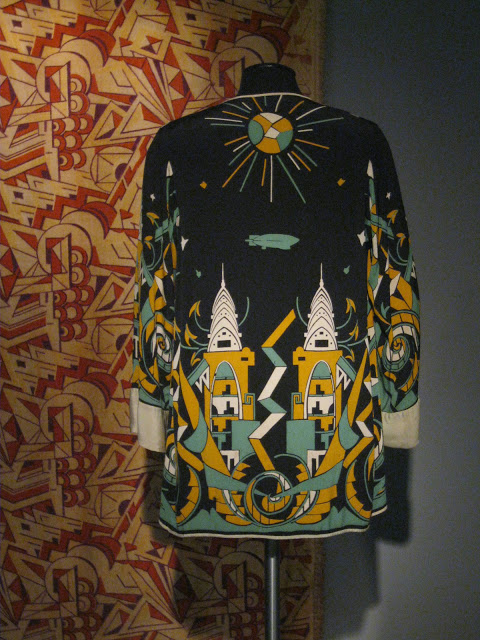
A silk crepe Art Deco jacket, circa 1926-1929, in front of a Paul Follot textile from 1926.

Fashion and Technology is now on view at The Museum at FIT through May 8, 2013. 100 garments, accessories and textile samples examine how technological advances in fabrics, dyes, and manufacturing techniques have changed how and what clothes are made, as well as how they alter fashion. The exhibit, curated by Ariele Elia and Emma McClendon, spans the fashion spectrum from the 18th century to the present day. Some of the earliest pieces in the exhibit show how the invention of sewing machines revolutionized garment construction, with long seams sewn on the machine but more delicate details left to the precision of hand-sewing, as shown in the wonderfully preserved 1865 cream silk taffeta wedding dress, being exhibited for the very first time.
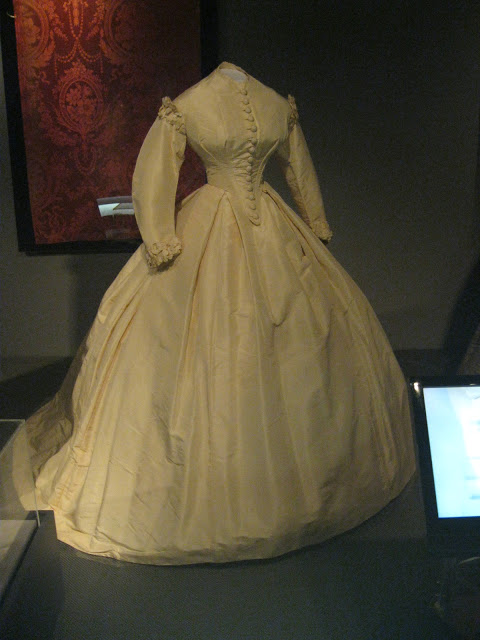
This 1865 wedding dress was made by machine and hand. (And look at that tiny waist!)

The accidental discovery in 1856 of aniline dyes by British chemist Sir William Henry Perkin meant that the color purple “very rare and difficult to produce” McClendon notes, and therefore reserved for royalty and the clergy, was now democratized, as the aniline dyes were much easier to mass produce.
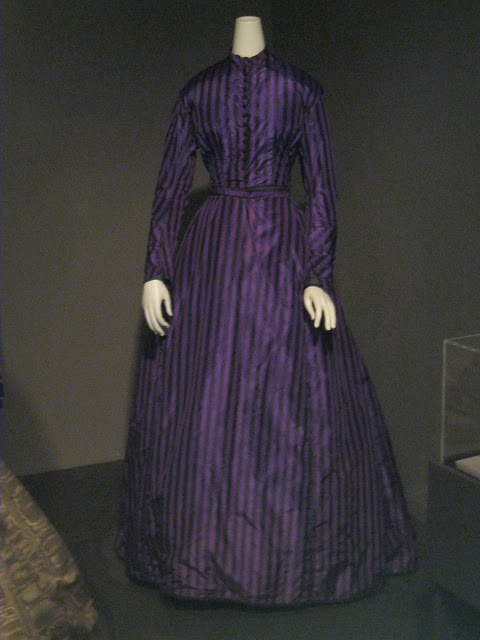
In the 1860s bright colors began to appear in clothes thanks to the discovery of aniline dyes.

While “manufacturers of sports clothes and the military are the first users of technological advances in fabric,” McClendon says, fashion designers are quick to adapt new fabrics and manufacturing techniques into their work as well.
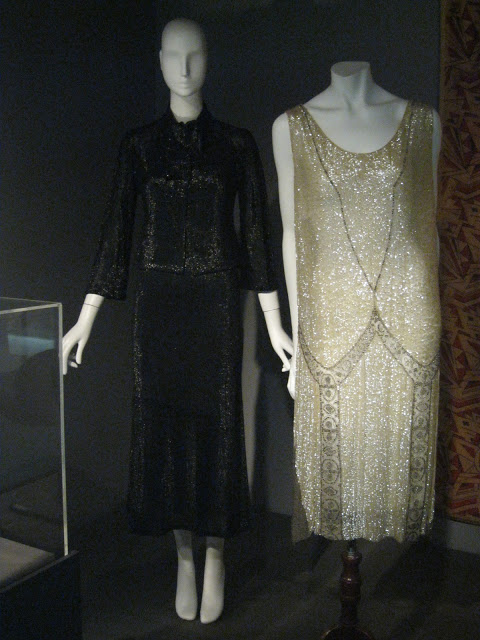
A black 1937 evening suit, left, and an ivory 1924 dress, right.

Both evening dresses above got their sparkle from the use of cellophane, a precursor to modern plastics, which was a breakthrough technology at the time.
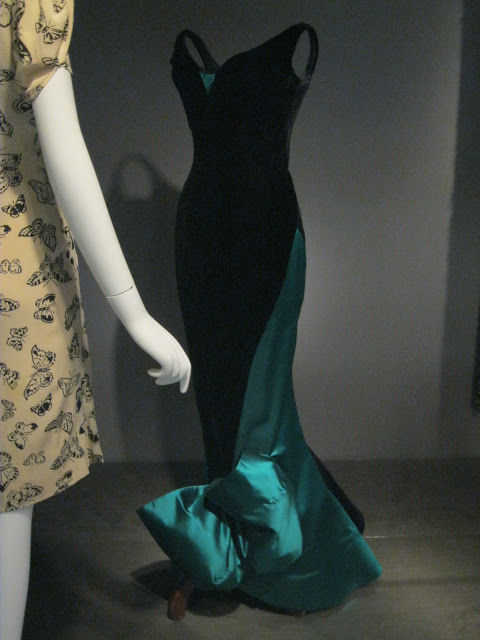
This 1955 Charles James dress uses a 3-foot long zipper that wraps around the body.

Charles James began placers zippers on the bias in his work in 1929. The metal zipper incorporated into the velvet and satin evening dress above is 3-feet long and spirals around the body.
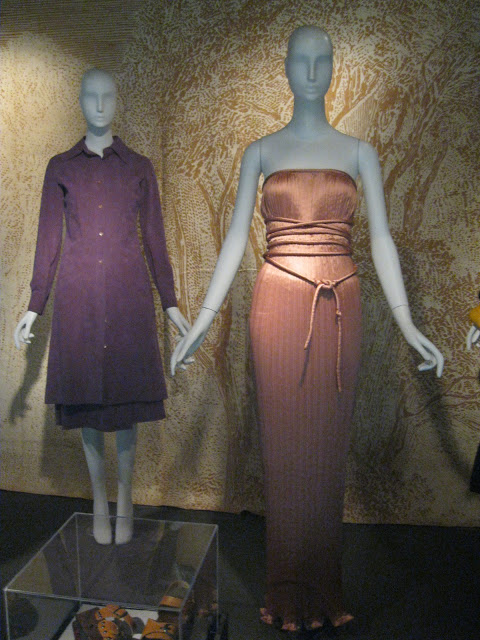
A 1975 Halston ensemble, left, and a 1977 dress by Mary McFadden, right.

Halston became known for his designs made in Ultrasuede, introduced in the 1970s by Toray, a Japanese company. Mary McFadden was able to achieve the amazing micropleating in this polyester dress from 1977 through the use of heat-set technology, which she pioneered in the 1970s. Prior to that designers had to hand-pleat silk, but the pleats often loosened over time. Heat-set pleating, meanwhile, is permanent.
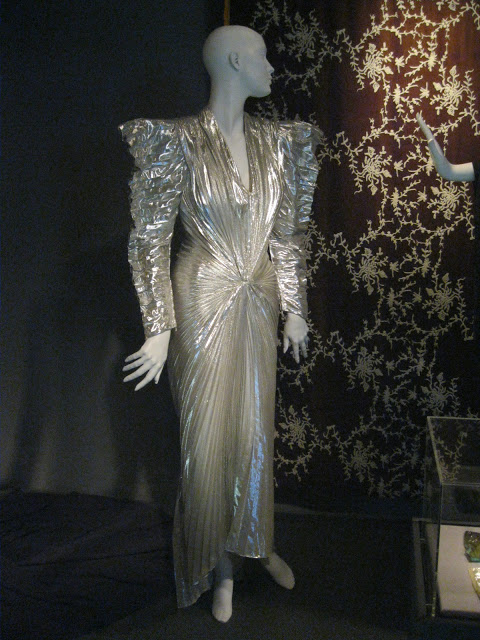
A Thierry Mugler dress of silver lamé from 1979.

Some of the pieces on view show how designers are inspired by ideas of the future. For instance Thierry Mugler’s 1979 silver lamé dress combined a futuristic aesthetic with a body-conscious silhouette. Kenneth Richard’s printed blue vinyl ensemble from 1996 and Jean Paul Gaultier’s printed nylon/spandex jumpsuit from 1995-1996 both highlight the designers’ ideas of what the sartorial future looks like.
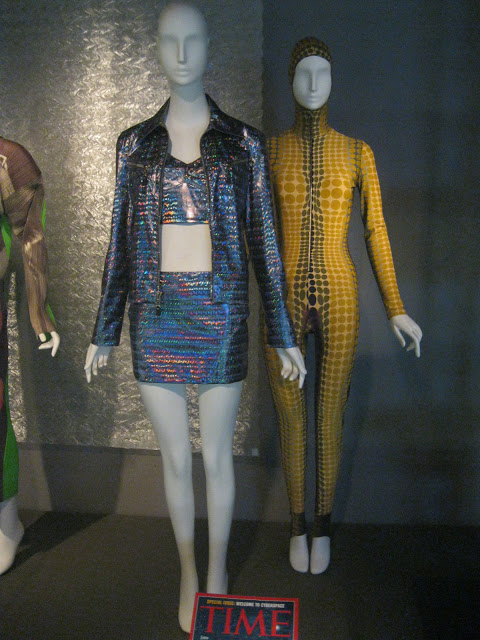
A 1996 Kenneth Richard ensemble, left, and a Jean Paul Gaultier jumpsuit from 1995-96.

A 2011 silver dress by Gareth Pugh, left, and a 2012 Louise Gray dress using a QR code print.

Gareth Pugh’s very futuristic silver polyurethane dress from 2011 actually contains a traditional tailoring technique—the slashes in the dress weren’t laser cut as they may appear but were done, says Pugh, “the good old-fashioned way—by hand, with a ruler and a blade.”
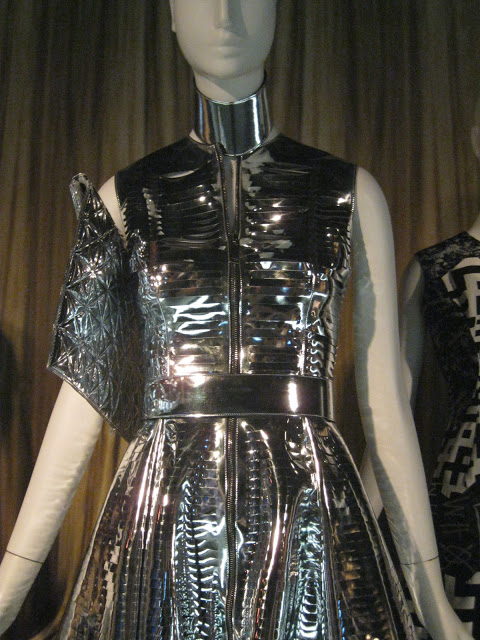
The slashes in this polyurethane dress were done by hand!

This fascinating exhibit provides a unique examination of how technological advances are quickly adapted by and incorporated into the world of fashion. And what a rare treat, to able to see a pristine Civil War-era wedding gown, a Charles James showstopper (you know how I love me some Charles James), and Halston and McFadden designs (among many others) all in the same exhibit—each designer, each unknown dressmaker and tailor, having ferried all of us into the future.

Fashion and Technology runs through May 8, 2013.

The Museum at FIT
Seventh Avenue at 27th Street
New York NY 10001-5992

Tuesday, December 4, 2012

How I Wear My: Plaid

Gap shirt, Children’s Place tie!

It’s the season for plaid! December seems especially suited to plaid—maybe because it pairs so well with black velvet?—so Adrienne of The Rich Life (on a budget) and I thought it was perfect for this month’s “How I Wear My” post.

This plaid tie belonged to my son when he was 2. I bought it for him to wear in Christmas pictures and because it was his first tie I can’t bring myself to get rid of it. Of course because it’s made for a toddler it’s way too short to wear in a regular way so I thought I’d wear it Duran Duran-style—tucked in midway like Simon and the rest of those fine English foxes did in the video “Is There Something I Should Know?” back in 1983.

Simon Le Bon of Duran Duran taught me how to wear a tie. I love him for it.

When I was 15 and 16 I took many sartorial lessons from Duran Duran, probably more from them (and Madonna) than any fashion magazine! (Completely unrelated side note: I lived in the Philippines at the time and felt like I was in a Duran Duran video since they always shot in such exotic locations. Those guys seriously could’ve filmed a video where I lived and it would’ve looked amazing).

Can I just say that self-portraits are hard?

To quote Simon, “Is there something I should say that would make you come my way?”

I think if I just add a black jacket and my stacked heel black patent loafers to this look I will be ready to hit the town for some (spiked) eggnog and caroling! With Duran Duran! And the gents and I will all wear our ties tucked in!

Oh what fun that would be. As long as we can sing “Girls on Film” or “Planet Earth” at some point.

After all the glitter and sparkle of the holidays, won’t it be nice to have a fashion palate cleansing? If you want to get back to basics please join Adrienne and me on January 3, 2013 for “How I Wear My: Black & White.” It’s a perfectly simple (yet always chic) way to ring in the New Year!

And do head over to Adrienne’s to see how others wear their plaid!