Wednesday, May 30, 2012

Spotlight: Valentino, Past & Present


When I first saw the two Valentino dresses on view as part of the exhibit Fashion, A-Z: Highlights from the Collection of The Museum at FIT, Part Two, now at The Museum at FIT, I made a guess as to the year of each. I was betting that co-curators Jennifer Farley and Colleen Hill had chosen to show one Valentino dress by Mr. Valentino himself, the other by Maria Grazia Chiuri and Pier Paolo Piccioli, the co-Creative Directors of the house since October 2008. I was right about that but wrong about who designed what. Care to take a guess as to the year each of these dresses were made?

Valentino dress of white cotton lace, rhinestones, and beads.

The one above is from 1965. The one below is from 2011. I love that the dress by Valentino himself feels so modern and the one by Maria and Pier Paolo is staying true to the history of the house by the use of black and white and exquisite details such as the feminine ruffles and the delicate appliqué flowers.

Valentino dress of ivory silk organza, and black and white cotton floral applique.

Fashion, A-Z: Highlights from the Collection of The Museum at FIT, Part Two is on view until November 10, 2012.

The Museum at FIT
Seventh Avenue at 27th Street
New York NY 10001-5992
212-217-4558
Hours: Tuesday-Friday: Noon-8PM
Saturday: 10AM-5PM
Closed Sundays, Mondays, and legal holidays
Admission is free

Friday, May 25, 2012

Fashion, A-Z, Part Two

Detail of a 1965 Norman Norell purple sequined "Mermaid" dress.

Fashion, A-Z: Highlights from the Collection of The Museum at FIT, Part Two opened May 23 at The Museum at FIT, and, like Part One, it’s a wonderful chance for anyone wanting to see a broad range of designers, both past and present, famous and not-so-famous, in the same exhibition. It’s also a peek into the permanent collection of FIT, which owns over 50,000 garments and accessories.

Burberry Prorsum by Christopher Bailey dress and coat, Fall 2010.

Co-curators Jennifer Farley and Colleen Hill have returned with a second show just as strong as the first. The concept of presenting designers in an A to Z format allows unexpected yet delightful pairings—such as a Jean Paul Gaultier trompe l’oeil dress next to Diane von Furstenberg’s shimmering golden gown—and also gives viewers the opportunity to see the work of different designers within one house, such as Balmain—a 1952 gown by house founder Pierre Balmain stands next to one by Oscar de la Renta for Balmain, who designed for the house from 1993 to 2002.

A 2002 Jean Paul Gaultier gown, left, a Diane von Furstenberg 2008 gown, right.

A Pierre Balmain gown from 1952, left, a 2002 Oscar de la Renta for Balmain gown, right.

A 2003 Missoni dress.

Another treat is a showing of one of Charles James’ “Tree” gowns, this one of pink silk taffeta from 1955. It’s a favorite of Ms. Hill, who noted that James only made 1,000 garments during his 50-year career and The Museum at FIT has one of the best collections of Charles James in the world. The museum also owns this dress in other colors—gold, green, and another pink—since James would often create the same gown for different clients in different colors.

A Charles James "Tree" dress of pink silk taffeta, 1955.

A 1961 "cocktail set" by Arnold Scaasi made with Liberty of London printed silk and fringe.

Ms. Farley is partial (as am I) to the stunning 1965 “Mermaid” dress by Norman Norell of purple silk jersey and purple sequins. Each sequin, she points out, was hand-stitched and reinforced. It’s an amazing dress and a testament to the skill and craftsmanship behind the Norell name.

This purple Normal Norell dress has been beautifully maintained. 

A book showcasing Fashion, A-Z will be released this fall and will include 500 photographs of permanent pieces from the museum’s collection, including the garments and accessories on display in Part One and Part Two of the exhibit. It will also feature an extensive essay on the history of fashion museums and exhibitions written by Dr. Valerie Steele, director and chief curator of The Museum at FIT.

Work by Thierry Mugler, NOIR, Norman Norell, Rick Owens, and Jean Patou.

Fashion, A-Z: Highlights from the Collection of The Museum at FIT, Part Two is on view through November 10, 2012.

The Museum at FIT
Seventh Avenue at 27th Street
New York NY 10001-5992
212-217-4558
Hours: Tuesday-Friday: Noon-8PM
Saturday: 10AM-5PM
Closed Sundays, Mondays, and legal holidays
Admission is free

Tuesday, May 22, 2012

Watching Bill Work

Schiaparelli dresses, from 1934 on the left, 1938 on the right.

So I’m standing inside one of the galleries at the Met during the press preview for the exhibit Schiaparelli and Prada: Impossible Conversations, taking pictures of Schiaparelli evening dresses from the 1930s when I glance to my right and see Bill Cunningham, the New York Times street style photographer, documenting a cluster of dresses next to the ones I was shooting. It’s always a thrill to see Bill and I decided to be smart and mildly shadow him to see if I could pick up any photography tips just by watching him work.

I picked up two.


Tip #1: Use Flash.

This may be old hat to you shutterbugs but it’s news to me since I consider myself a writer first, photographer second.

Clothes are sensitive to light, which is why regular museum-goers are not allowed to take photographs in costume exhibits at the Met (and the guards will yell at you if you do, or even toss you out, as I once witnessed). The curators don’t want the garments exposed to the light of many flashbulbs over a period of a couple of months. At most press previews I attend flash is NOT used by the professional photographers. You will see it used by video cameramen (in the form of a steady bright light) but many of the still photographers, some of whom even work for the New York Times as Bill does, don’t use flash, so I got used to not using it either.

Bill, however, used flash, in every shot throughout the exhibit. I tried shots without it, and then with it, and it was very interesting to see the difference in the results. Without the flash, I got more of a feel of the exhibit itself, and the experience of being in it. With the flash, it’s all about the clothes—the details and the color of the garments come to life.

Without flash. You get more of a sense of the exhibit than the dress.

With flash. The colors of the dress (and the mannequin head) stand out.

Tip #2: Take Your Time.

When I was standing with everyone else in the European Sculpture Court listening to the remarks given by Thomas P. Campbell, the Met’s Director, Harold Koda, Curator in Charge of the Costume Institute, and Andrew Bolton, Curator, the Costume Institute, a flash of blue caught my eye. It was Bill, in his trademark blue smock, slowly working his way through the crowd, stopping here and there to take pictures of media people in the audience. He was the only one walking around and he didn’t rush, he moved through at a deliberately slow pace, camera at the ready. After the remarks he asked one woman in particular to stop for a picture. She wore a black trompe l’oeil sweater with strands of pearls woven into the design.

Bill at work.

Schiaparelli got her start in fashion making trompe l’oeil sweaters in the early 1930s and I’m convinced that because Bill saw one of those sweaters in the exhibit he couldn’t resist taking a photograph of the only woman in the room wearing one herself.

Schiaparelli sweaters from the 1930s. I wish I owned the one on the right.


Maybe you’ll see this lady in a future “On the Street” feature on the New York Times website. Remember you saw her here first!

Wednesday, May 16, 2012

What Anna Wore

Anna in Prada for the Met Gala 2012. Photo by Larry Busacca.

I thought it would be fun to recap what Vogue Editor in Chief Anna Wintour wore last week to the Met’s Costume Institute Gala to celebrate the opening of Schiaparelli & Prada: Impossible Conversations.

It’s no surprise that she opted for Prada instead of the Chanel she usually favors for the Gala and I loved the wink-wink aspect of her dress—it is Miuccia Prada’s rendition of Elsa Schiaparelli’s iconic “Lobster” dress.

What a gorgeous evening ensemble. Photo by Dimitrios Kambouris.

I'm dying over the necklaces, the capelet and the perfect hair! Photo by Dimitrios Kambouris.

In Prada’s version, the lobster, in heavy beading, winds around the dress, and you can see in the detail shot that sizeable stones in different shades of topaz and gold were used. To complete the look Anna added a white fur capelet—I’m not sure if it’s by Prada but knowing Anna it’s probably real fur—and her stack of Georgian-era gemstone collet necklaces.

Amazing beading on the dress. Photo by Dimitrios Kambouris.

Detail of the dress and Anna's watch and ring. Photo by Dimitrios Kambouris.

The lobster is also a dress strap. Anna with Miuccia Prada. Photo by WWD.

For the after party, obviously a more casual affair (and who knew there was an after party?), she wore this lovely black print dress with a circle skirt. I’ll bet it was Prada.

I love this dress for the after party. Photo by Bauer Griffin.

Earlier in the day, when I saw her at the press preview for the exhibit she wore a fabulous green geometric-patterned jacket and skirt, also by Prada, with her old standby Manolo Blahnik heels.

Anna with her assistant at the end of the press preview. Photo by me!

One photographer yelled, "Anna, quick fashion shot?" And she obliged. By Simon Russell.

Anna with Met director Thomas P. Campbell. And that's me in the background, in blue!


What did you think of Anna’s look?

Thursday, May 10, 2012

Schiaparelli and Prada: Impossible Conversations

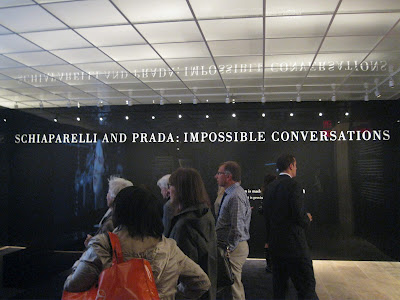
The entrance to the exhibit.

This year’s Costume Institute exhibit, Schiaparelli and Prada: Impossible Conversations, opens to the public today at The Metropolitan Museum of Art.

The premise of the show is a dialogue, in words and clothes, between two iconic Italian women designers—Elsa Schiaparelli and Miucci Prada—divided by decades but sharing a similar off-beat and provocative aesthetic examined through three ideas of chic: Hard Chic, Ugly Chic, and Naïf Chic.
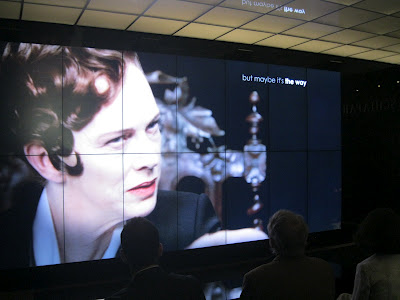
Judy Davis plays Elsa Schiaparelli in her dialogue with Miuccia Prada.

In his remarks to the press on Monday, Harold Koda, Curator in Charge of The Costume Institute, noted that the Met was the recipient of a large number of works by Elsa Schiaparelli given to them in 2009 by the Brooklyn Museum—many of which were on display in Brooklyn during the gorgeous show American High Style: Fashioning a National Collection in 2010—and it was this gift, coupled with the idea by Mr. Koda and curator Andrew Bolton to showcase two women designers together, which made the timing seem right for an exhibit of this kind.

Koda and Bolton were not interested in just a side-by-side past/present comparison, Mr. Koda noted, but were looking more for an “abstract environment,” a “conversation between designers.”
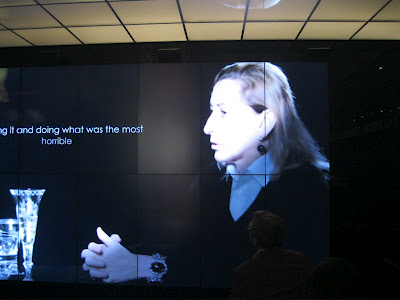
Prada talks with Schiaparelli about how she found her way into fashion.

But how do you do this when one of the designers in question died in 1973? You bring Judy Davis on board to play Elsa Schiaparelli (inspired casting, I have to say) and hire Baz Luhrmann, director of Moulin Rouge! and this year’s highly anticipated remake of The Great Gatsby, to help stage the whole thing. The two women, Davis and Prada, never even met. Miuccia Prada was interviewed by Andrew Bolton and Schiaparelli’s part of the dialogue, taken from her 1954 autobiography Shocking Life, was acted by Ms. Davis at a completely different time and place. Put together, you can’t imagine that Schiaparelli and Prada aren’t in the same room. The conversation, set at an elaborate table and inspired by the film My Dinner with Andre kicks off the exhibit and then reappears throughout it, Schiaparelli and Prada’s faces and conversation instantly popping to life behind the clothes. If you’d like to see the videos for yourself click here.
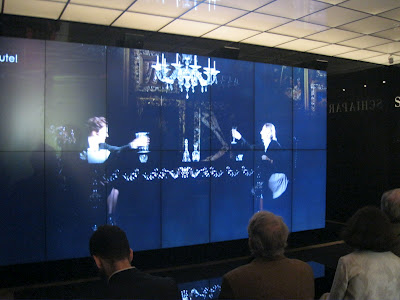
Schiaparelli and Prada toast each other at the end of their discussion.

In galleries that examine how each designer expresses the Classical Body, the Exotic Body, and the Surreal Body, not only do the imaginations of Schiaparelli and Prada seem endless, as do their use of unexpected materials, patterns and shapes, but both designers push viewers of their work to question accepted ideals of youth, beauty and femininity.
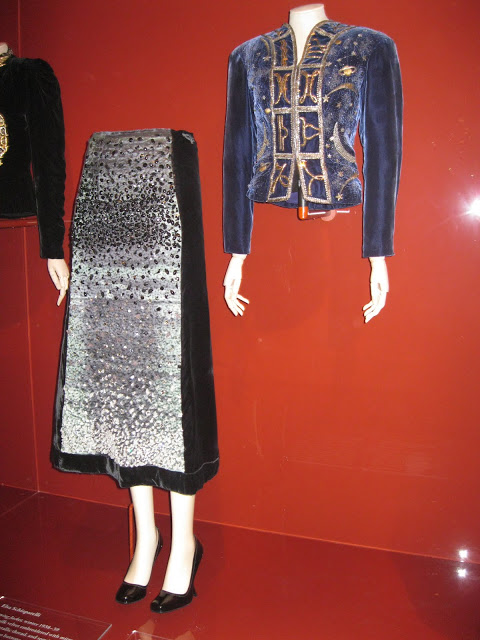
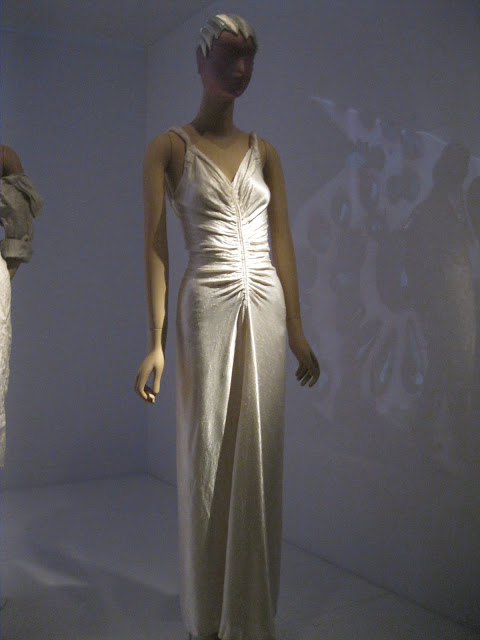
Prada skirt autumn/winter 2004-5, Schiaparelli evening jacket,  summer 1937.

A Schiaparelli ivory silk velvet dress, 1936. Gorgeous!

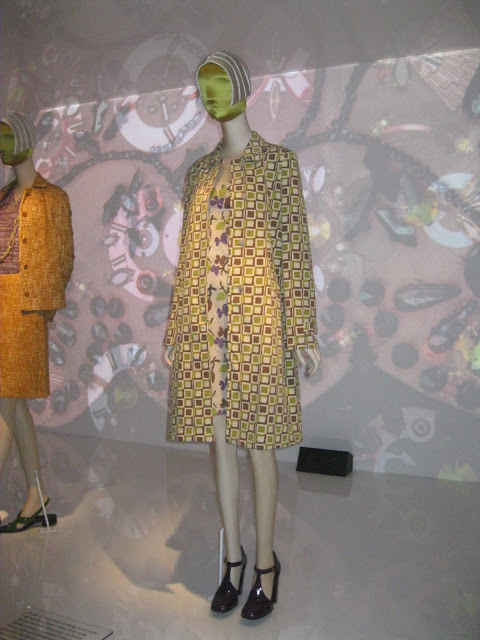
Prada ensemble, spring/summer 1996

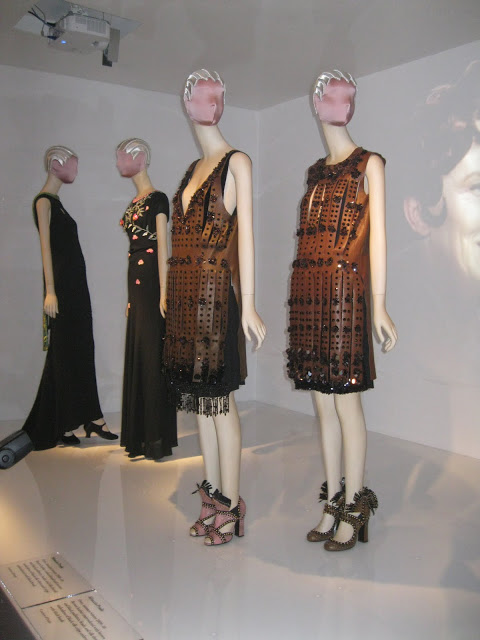
Prada leather dresses from 2009-10 mingle with Schiaparelli black dresses from the 1930s.

Schiaparelli ensemble, 1938.

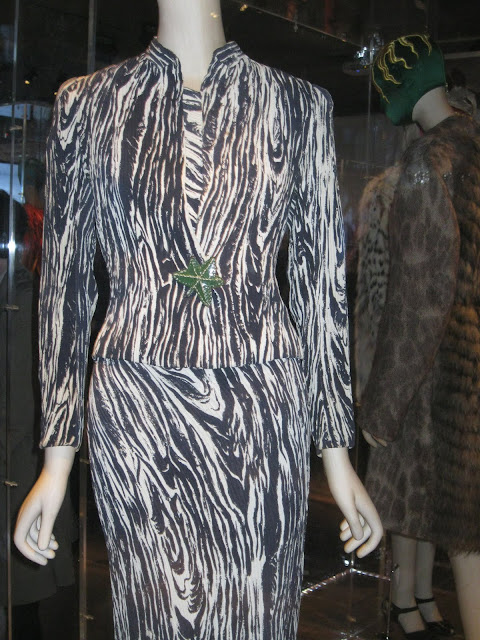
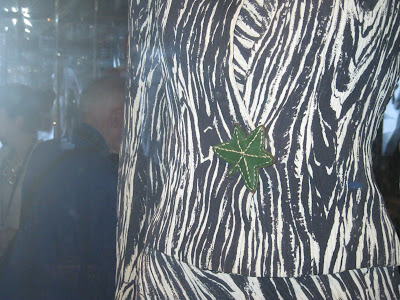
White matelassé silk printed in wood grain pattern with leaf-shaped button.

Bill Cunningham is on the left. He walked into my shot!

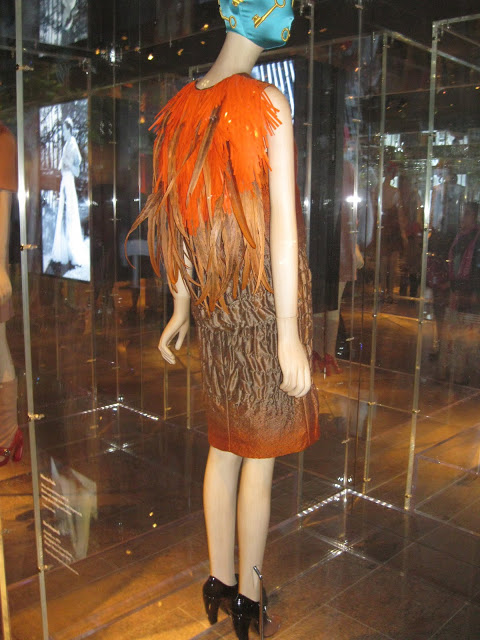
Prada dress, 2007-8, brown and orange ombré wool, orange plastic fringe, and feathers.

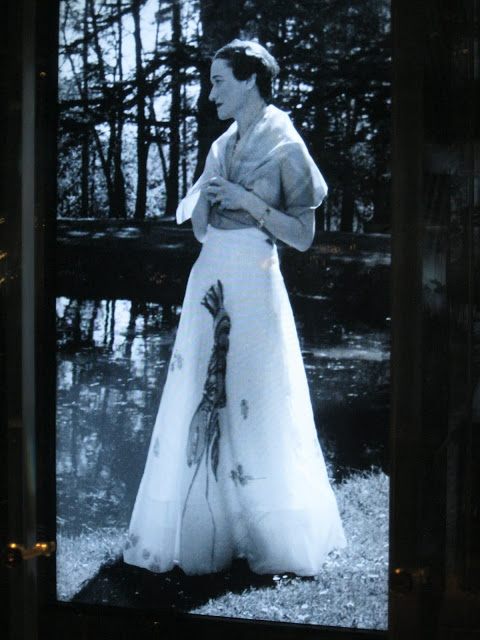
Wallis days before she married Edward in 1937 in Schiaparelli's famous "Lobster" dress.
Photo by Cecil Beaton.


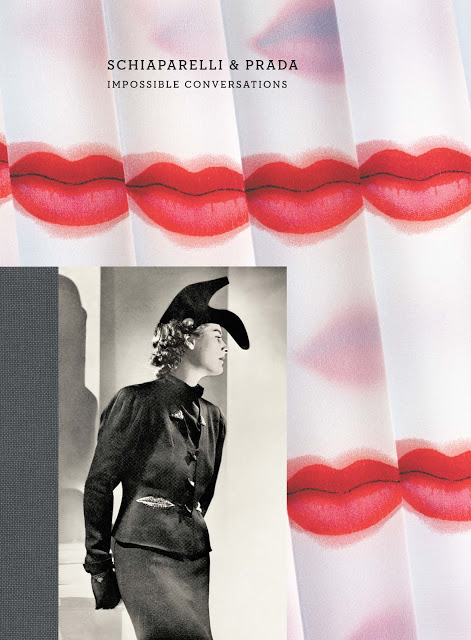
The exhibit catalogue cover.

Schiaparelli and Prada: Impossible Conversations runs through August 19, 2012.

The Metropolitan Museum of Art
1000 Fifth Avenue at 82nd Street
New York NY 10028
metmuseum.org

Wednesday, May 9, 2012

The Essentials of Fabulous Giveaway Winner!


Thanks to everyone who left a comment last week about The Essentials of Fabulous: Because Whatever Doesn’t Work Here Anymore by Ellen Lubin-Sherman. I’m excited to have my first giveaway and to share a copy of a book I truly enjoyed.

I decided to do things the old-fashioned way, that is, names in a bowl. To be slightly more precise, a pale-pink gorgeous Depression glass bowl my mother gave me as a present some years ago. I don’t know the name of the pattern but I love it and I use this tiny bowl whenever I get a chance.


Depression glass bowl. I can't remember the pattern name but it's lovely!

The winner is:


Congratulations, Denise! Please send your address to me at [email protected] and I will mail the book to you!

Thanks to everyone who participated. I didn’t realize giveaways were this fun so I hope to do another in the future.

Sunday, May 6, 2012

Last Call: Fashion, A-Z, Part One

Armani Privé, Fall 2007

This dress features 100,000 "Diamond Leaf" Swarovski crystals, designed by Armani.

Tuesday, May 8 is the final day to see the lovely and informative exhibit Fashion, A-Z: Highlights from the Collection of the Museum at FIT, Part One. It really is a trip down fashion memory lane with the inclusion of so many designers, both famous and not-so-famous, from the last century to today, and every piece is from the museum’s permanent collection. Can you imagine?

Part Two of the exhibit opens May 23 and I can hardly wait to see what young curators Jennifer Farley and Colleen Hill have selected to put on display. I can tell you for sure that there are vintage Christian Dior and Charles James gowns I cannot wait to see!

A 2006 Jean Yu dress of black and white silk matte jersey and black grosgrain.

I cannot get over the details of the back of this dress. So sexy!

The Jean Yu dress flanked by Yeohlee on the left, Zoran on the right.

The Museum at FIT
Seventh Avenue and 27th Street
New York NY 10001-5992
212-217-4558
Hours: Tuesday-Friday: Noon-8PM
Saturday: 10AM-5PM
Closed Sundays, Mondays, and legal holidays
Admission is free